
Table of Contents
Starting a New Career in Barbering
Feeling stuck in a dead-end job? Many adults dream of a fresh start in a creative field like barbering. Consider a hair school career change in Midvale, Utah, where The Barber School offers vocational training that turns passion into profession. With no prior experience needed, this path welcomes career changers ready to become a hairstylist or explore a cosmetology career switch.
Located at 16 West 7200 South in Midvale, The Barber School emphasizes hands-on learning through its student barbershop, providing low-cost services to the public–from $7 haircuts to $3 beard trims–while building real-world skills. This model suits working adults, offering flexible schedules and creative outlets in the beauty industry. Addressing financial barriers, options like barber school financial aid make transitioning to barbering education accessible. The school upholds a non-discrimination policy and ADA compliance, ensuring accommodations for disabilities through coordinator Lyndi Keisel.
According to beauty career experts, it’s never too late to switch; many thrive in their 40s, like a former office worker who now cuts hair full-time after completing the program. This guide explores understanding the transition, key benefits, the enrollment process, and best practices for success, helping you decide if switching to beauty industry training fits your life.
Understanding the Career Switch to Barbering
Switching careers to barbering offers a fresh start in a creative and rewarding field, especially through programs tailored for adults. In Midvale, Utah, The Barber School provides a structured path that supports those eyeing a hair school career change. This section helps you evaluate if this move aligns with your goals, addressing doubts with practical insights.
Assessing Your Readiness for Barber School
Embarking on a hair school career change in Midvale, Utah, starts with honest self-reflection. Consider your passion for creativity and interacting with people, as these traits fuel success in barbering. Ask yourself: Do you enjoy hands-on work that transforms appearances and boosts confidence? A simple self-quiz can clarify your fit.
- Motivation Check: Are you drawn to the artistic side of styling hair, or seeking stable income in a growing industry?
- Lifestyle Fit: Can your schedule accommodate classes while balancing work or family? The Barber School’s flexible options suit working adults.
- Skill Alignment: Strong communication and manual dexterity are key for building client relationships.
Many career switchers find barbering rewarding after assessing these factors. For instance, a former office worker discovered fulfillment in styling through trial consultations. This evaluation ensures the beauty field entry for adults feels right, setting a solid foundation for your barbering path transition.
(Word count: 152)
Transitioning smoothly requires recognizing potential obstacles, yet solutions like vocational training make them manageable.
Common Challenges in Transitioning to Hairstyling
A cosmetology career switch often involves hurdles like lacking prior experience and financial pressures. Many worry about starting from scratch, but programs designed for beginners ease this. To become a hairstylist with no background, focus on structured vocational training that builds skills step by step.
Time commitment poses another barrier, with full-time classes demanding adjustments. The Barber School counters this with flexible scheduling for adult learners, allowing part-time attendance. Financial concerns, such as tuition costs, are addressed through aid options; for example, federal grants and beauty school scholarships can cover up to 70% of expenses, based on success rates from similar institutions. Licensing basics are straightforward for newcomers, requiring completion of a hair design program barber school followed by state exams.
Real-world examples show switchers overcoming these via school support, including grievance procedures and leave policies that accommodate life events. By tackling experience gaps head-on, you pave the way for a viable hairstyling career.
(Word count: 148)
Beyond challenges, myths about age and background can deter potential barbers, but evidence from supportive schools dispels them.
Age and Experience Myths in Cosmetology
One common misconception is that cosmetology suits only the young, yet adults over 40 thrive in barbering with the right resources. The Barber School debunks this by offering tailored support for mature learners, emphasizing that experience from other fields transfers well. For instance, a mid-career switcher in sales leveraged people skills to excel in client consultations.
Another myth claims prior beauty knowledge is essential, but no-experience entrants succeed through hands-on clinical practice in the student barbershop. Midvale’s location enhances accessibility, with low-cost services providing real-world exposure. School policies, like ADA compliance and academic adjustments, ensure inclusivity for all ages.
Debunking these fosters confidence: Is becoming a hairstylist a good career change? Absolutely, especially with institutional backing that prioritizes diverse entrants. How to switch career to cosmetology? Start by leveraging flexible programs that affirm your readiness at any stage, turning myths into motivators for success.
(Word count: 150)
Overall, these insights empower your decision, highlighting The Barber School’s role in making barbering accessible and fulfilling.
(Total word count: 450)
Benefits of a Barbering Career Change
Transitioning to a career in barbering offers transformative opportunities for those seeking a fresh start later in life. At The Barber School in Midvale, Utah, this path combines practical training with real-world application, making it an appealing option for working adults. The school’s student barbershop model not only builds essential skills but also highlights the profession’s rewards, from financial stability to personal fulfillment.
Financial and Lifestyle Advantages
A hair school career change in Midvale, Utah, brings notable financial and lifestyle benefits that suit professionals switching paths mid-career. Barbers often earn a competitive salary supplemented by generous tips, with entry-level positions averaging $30,000 to $50,000 annually in Utah, according to industry reports. This income potential allows for financial independence without the exhaustion of traditional 9-to-5 demands.
Flexible hours stand out as a key perk, enabling barbers to set schedules around family or other commitments. The Barber School’s program accommodates working adults through evening classes and part-time options, fostering work-life balance. Consider a former office worker who now enjoys weekends off while serving clients during peak times, illustrating how this shift enhances daily living.
- Income Boost: Tips can add 20-30% to base pay, rewarding skilled service.
- Schedule Freedom: Many barbers operate independently, choosing hours that fit personal needs.
- Low Barrier Entry: Affordable training leads to quick employment in Utah’s growing beauty sector.
These advantages make barbering a viable second career, promoting both economic security and reduced stress.

Icons illustrating key benefits of a barbering career change
Skill Development Through Hands-On Training
Hands-on training at The Barber School equips learners with practical skills essential for success, making it ideal for those aiming to become a hairstylist. The student barbershop provides real-client interactions from day one, allowing students to practice cuts, shaves, and styling under supervision. This clinical model, open Tuesday through Saturday with low-cost services like $7 haircuts, builds confidence through immediate feedback.
Gains from barber training include precision cutting and client consultation, core skills drawn from cosmetology programs that prepare individuals for professional environments. Students learn to tailor services to diverse needs, enhancing creativity and technical proficiency. For instance, a mid-career changer with no prior experience might master beard trims in weeks, thanks to the school’s supportive structure.
The program also offers academic adjustments for students with disabilities, coordinated by the ADA Compliance Officer, ensuring inclusivity. Brief success stories, like a veteran transitioning via this training, highlight how these experiences foster lifelong competencies.
- Practical Application: Serve walk-in clients at prices starting at $1 for mustache trims.
- Creative Growth: Experiment with styles in a low-pressure setting.
- Client Skills: Develop rapport through genuine consultations.
For more details, explore barber school class information.
Long-Term Job Prospects and Satisfaction
A cosmetology career switch promises strong job prospects and deep satisfaction, particularly for later-life entrants in Utah’s robust beauty industry. Demand for barbers remains steady, with the sector projected to grow 8% by 2030, offering roles in salons, freelance work, or even entrepreneurship. Midvale’s community focus amplifies opportunities, as graduates tap into local networks built during training.
Emotional rewards of beauty profession shift include social connections and creative expression, countering previous career monotony. Many find fulfillment in helping clients feel confident, with one alum noting, “Barbering reignited my passion after years in corporate drudgery.” Stability comes from versatile skills applicable across settings, supported by the school’s grievance procedures and leave policies for sustained progress.
Inclusivity extends to all, with resources like the net price calculator aiding diverse applicants. This path not only secures employment but also enriches life with purpose and camaraderie.
- Market Stability: Utah’s beauty jobs outpace national averages.
- Personal Fulfillment: Daily interactions build meaningful relationships.
- Entrepreneurial Potential: Open your own shop post-certification.
Overall, these factors affirm barbering as a fulfilling, future-proof choice.
How Barber School Training Works
The Barber School in Midvale, Utah, offers a structured path for those pursuing a barber school programs education, making it an ideal choice for adults seeking a fresh start in the barbering field. This vocational training combines theoretical knowledge with practical skills, equipping newcomers with the tools to succeed. Whether you are exploring a hair school career change in Midvale, Utah, or simply curious about the barber program mechanics, understanding the training workflow for newcomers reveals a clear, supportive journey to professional certification.
Enrollment and Program Structure
Enrolling at The Barber School begins with a straightforward application process tailored for working adults and career changers. Start by visiting the school’s website to use the net price calculator, which helps estimate costs based on your financial situation. Next, submit your application online or call admissions at 801-666-4743 to schedule an interview, where staff discuss your goals and confirm eligibility. No prior experience is required, and there is no vaccination mandate, ensuring accessibility for all prospective students.
Once accepted, the program spans 1,200 hours over approximately 10 months, running Tuesday through Saturday to accommodate schedules. The curriculum integrates classroom instruction on barbering theory, sanitation, and client consultation with hands-on preparation. Students benefit from robust support, including leave of absence policies for life events and clear grievance procedures to address concerns. This structured approach demystifies the steps to start a career as a hairstylist, providing a solid foundation from day one.
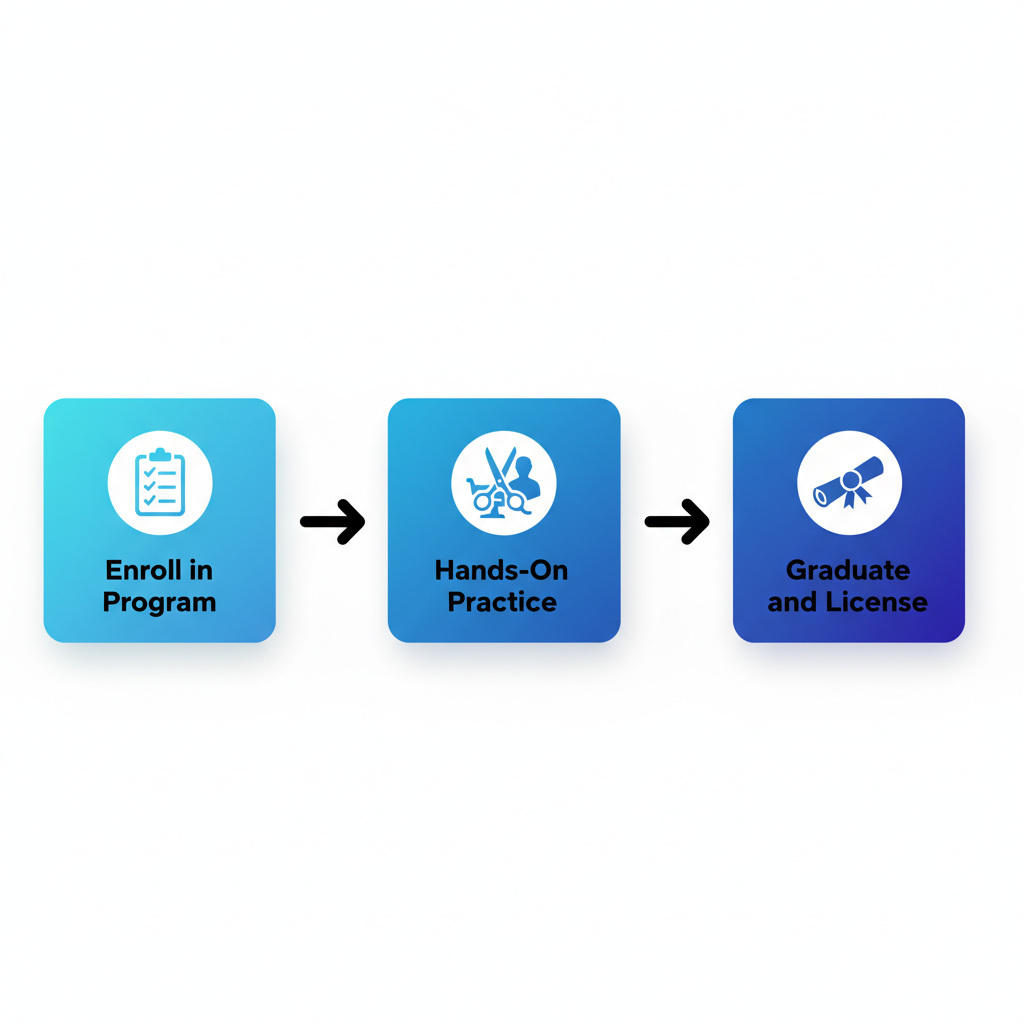
Barber school training process: enrollment to graduation
Hands-On Practice in the Student Barbershop
At the heart of the training lies the student barbershop, where theoretical lessons evolve into real-world application. Open to the public Tuesday through Friday from 10:00 a.m. to 7:00 p.m. and Saturday from 8:30 a.m. to 4:15 p.m., the shop allows students to practice on actual clients under supervision. This clinical environment fosters the skills needed to become a hairstylist, emphasizing precision in cuts, shaves, and styling.
Services are affordably priced to attract community members, such as haircuts for $7, senior haircuts for $5, head shaves and gentleman shaves for $5 each, beard trims for $3, mustache trims for $1, scalp treatments for $3.50, and shampoos for $2.50. These low-cost offerings provide ample opportunities for repetition and feedback, helping students refine techniques while serving the Midvale community. Instructors guide each session, ensuring safety and quality, which builds practical expertise essential for professional readiness.
This hands-on model not only hones technical abilities but also develops client interaction skills, preparing graduates for the demands of a bustling barbershop.
Licensing and Graduation Process
As the program nears completion, focus shifts to preparing for Utah’s barber licensing exam, a key milestone in any cosmetology career switch. Students review coursework through mock exams and skill demonstrations, covering topics like haircutting, chemical services, and state regulations. The school provides dedicated prep sessions to boost confidence, with a high pass rate reflecting effective guidance.
Graduation requires fulfilling all 1,200 hours and passing internal assessments, followed by applying for the state exam through the Utah Division of Occupational and Professional Licensing. Successful examinees receive their license, enabling immediate employment. For career changers, the adaptable structure suits late starters, as noted in resources on switching to beauty careers, offering motivation through flexible timelines and post-graduation support like job placement assistance and alumni networks.
The Barber School’s director, Kim Hatch, and ADA coordinator, Lyndi Keisel, ensure inclusive processes, including accommodations for disabilities. Contact admissions at 801-666-4743 for exam details. This comprehensive pathway empowers newcomers to transition smoothly into a rewarding barbering profession.
Best Practices for a Successful Barber Career Transition
Transitioning into barbering demands strategic planning to ensure long-term success. At The Barber School in Midvale, Utah, these best practices focus on financial stability, skill development, and resilience. By leveraging school resources, aspiring barbers can navigate the hair school career change in Midvale, Utah, with confidence and efficiency.
Financial Planning and Aid Strategies
Effective transition tactics begin with solid financial groundwork. Start by assessing your budget against barber school tuition fees barber school tuition fees, which are structured to support working adults. Create a monthly plan that allocates funds for living expenses, transportation, and program costs, aiming to save at least 10-15% of income beforehand.
Leverage low-cost options like the student barbershop’s walk-in services to offset expenses while gaining experience. For instance, offering beard trims at 3 USD allows students to earn pocket money during training. Apply for financial aid early; as outlined in resources for vocational programs, scholarships and grants can cover up to 50% of costs. Quote from aid guides: “Federal Pell Grants provide need-based funding without repayment, while school-specific scholarships reward academic promise.” Contact admissions at 801-666-4743 to explore eligibility and application steps, including FAFSA submission by priority deadlines.
- Checklist for budgeting: Track income versus school fees; research employer tuition reimbursement; utilize net price calculators on the school site.
Avoid the pitfall of underestimating indirect costs like supplies; build a contingency fund of 500-1,000 USD. These steps ensure a sustainable approach to funding your barbering journey.
Building Skills and Networking During Training
Hands-on practice forms the core of success keys in barbering. Maximize time in the student barbershop, open Tuesday through Friday from 10:00 am to 7:00 pm and Saturdays from 8:30 am to 4:15 pm. Schedule regular shifts for services like haircuts at 7 USD or head shaves at 5 USD, focusing on precision techniques to build confidence.
To become a hairstylist with no prior experience, develop a portfolio by documenting client transformations with permission. Practice routines should include daily drills on mannequins followed by live appointments, dedicating at least 20 hours weekly. Warn against skipping repetition; consistent effort prevents skill gaps that hinder job readiness.
Networking amplifies opportunities. Engage local stylists during community events or shop visits, exchanging contacts for mentorship. Join Utah barber associations and attend open houses at The Barber School. Action steps include:
- Volunteer for extra shop hours to interact with diverse clients.
- Create a professional social media profile showcasing your progress.
- Seek feedback from instructors on techniques like fading and styling.
These connections open doors to apprenticeships and entry-level positions post-graduation.
Overcoming Obstacles and Seeking Support
A cosmetology career switch often involves hurdles like time management or personal setbacks. Combat scheduling conflicts by reviewing leave of absence policies, which allow flexible pauses without penalty for up to 180 days. Balance work and studies by prioritizing high-impact classes first.
School resources provide vital backing. Reach out to Director Kim Hatch for personalized guidance on curriculum adjustments. For disabilities or accommodations, contact ADA Coordinator Lyndi Keisel to request academic adjustments through formal procedures, ensuring equitable access.
Address common pitfalls head-on; for example, motivation dips can be countered with peer study groups. The school’s non-discrimination policy supports all learners, including those without vaccinations. Resource lists for support:
- Grievance procedures via administrative office.
- Consumer information pages for policy details.
- Barbershop line at 801-304-7000 for immediate assistance.
By utilizing these, students transform challenges into growth opportunities, paving the way for a rewarding barbering career.
Embracing Your Barbering Journey
Embarking on a hair school career change in Midvale, Utah, opens doors to a rewarding path at The Barber School, where adults transition successfully into barbering. This guide has explored readiness for second careers, the benefits of hands-on training, and essential practices that build confidence and skills. Whether aiming to become a hairstylist or pursuing a cosmetology career switch, the journey emphasizes practical experience through the school’s student barbershop, offering low-cost services like 5 USD shaves and haircuts starting at 7 USD.
The Barber School supports your growth with inclusive policies, including non-discrimination and ADA compliance, ensuring accessibility for all learners. Discover how barber school founder tim hite envisioned a program fostering barber path fulfillment and beauty career culmination. Graduates often share success stories of personal fulfillment and stable job prospects in Utah’s vibrant beauty industry, proving it’s never too late to switch careers by going to beauty school. Key skills learned, such as precision cutting and client interaction, prepare you for thriving roles, aligning with proven cosmetology programs that validate long-term viability.
Ready to start? Contact admissions at 801-666-4743 or visit during barbershop hours: Tuesday-Friday 10:00 am-7:00 pm, Saturday 8:30 am-4:15 pm. Take these next steps:
- Schedule a tour to experience the hands-on environment.
- Enroll today for transformative vocational education in Midvale.